Barbed Wire Fence in Columbia, MO
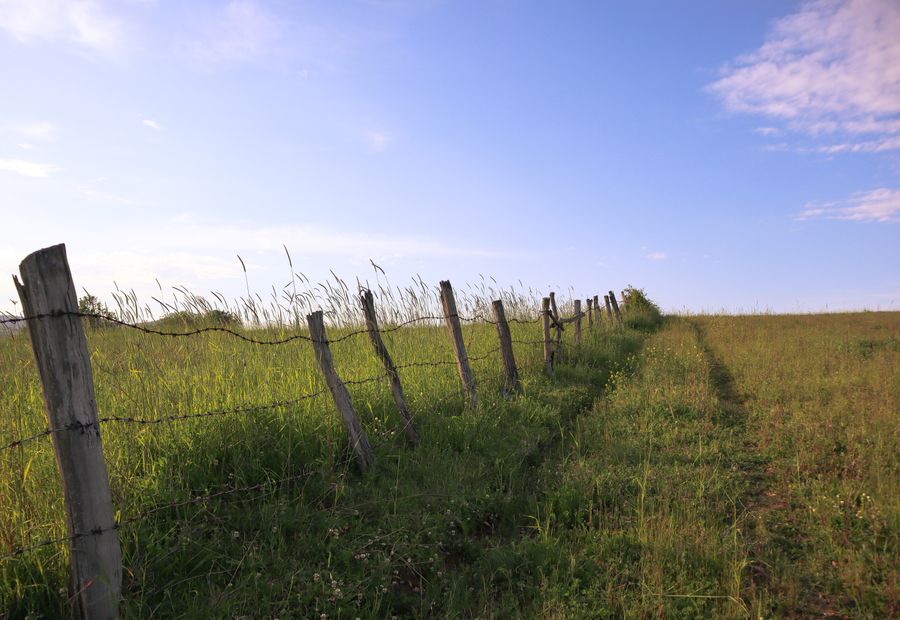
Columbia Farm Fence builds barbed wire fence for cow-calf pasture, boundary lines, and cross fencing across Columbia, Hallsville, Centralia, Sturgeon, Harrisburg, and the cattle ground of Boone, Audrain, Randolph, and Callaway counties, Missouri. Barbed wire is a cattle fence. We build it for cattle and spec something else for horses and goats.
We buy wire on the spec sheet, not on the price tag. We run Red Brand for traditional soft barbed wire and Bekaert Gaucho where a customer wants high tensile barbed wire, which puts the same holding strength in a lighter roll and holds tension longer between checks. Both carry Class 3 galvanized coating, roughly three times the zinc of Class 1, and on a barbed strand the coating matters most right at the barb where the twist exposes steel. Corners, ends, and gate openings are wood H-braces on CCA ground contact posts six to eight inches across, set three and a half to four feet down and tamped in lifts. Driven steel T-posts carry the line between those assemblies at eight to twelve feet. T-posts hold the wire up. They do not hold the wire back, and a fence cornered on a T-post is a fence with slack strands within a year.
Bottom and Upland Set Differently
Barbed wire pulls hard, and the end assembly is only as good as what surrounds it. Missouri River bottom ground near Rocheport and McBaine is deep, soft alluvium that augers easily and gives back less grip, so brace posts go deeper and the H gets longer between posts. Upland claypan grabs a post well once it is packed, but the tight clay below the topsoil holds water, slicks the hole in the wet, and lifts posts after a hard freeze. We tamp the backfill in layers on both soils. Concrete around a wood post traps water at the ground line and rots the post from the collar out.
Stretching and the Line
Each strand goes up separately and gets pulled from a braced end, not from the last T-post. The fence follows the ground over rises and through draws so nothing crawls under at a low spot. Where the line crosses water we hang a floodgate rather than run wire across the channel and lose it in the first rain.
Free Estimate
Barbed wire is the least expensive foot of fence we build, and the corner count is what moves the quote. Call (573) 555-0157.
How many strands does a cattle fence need?
Five is the working standard around here. That puts the top wire near four and a half feet and the bottom wire about a foot off the ground, with the gaps closing up toward the bottom because that is where calves try to get out. Four strands will hold quiet, well fed cows on flat ground. Bulls, weaning pens, and any fence along a road get six.
What is the difference between two point and four point barbs?
The count is how many barb tips are twisted onto the strand at each point. Two point barbs are spaced wider and are easier on hands and hides, which suits cross fencing and quiet cattle. Four point barbs sit closer together and hit harder, which is what you want on a boundary or where stock test the line. Red Brand sells both, and we run whichever the job calls for rather than one by default.
Should barbed wire go around horses?
We advise against it. A horse that hits barbed wire at speed cuts badly, and horses do not see a thin wire the way cattle do. If a horse pasture already has barbed wire on the boundary, the usual fix is a hot wire or a sight rail set inside it to keep the horse off the barbs. New horse fence should be board, rail, mesh, or coated smooth wire.
Can barbed wire be repaired, or does the run have to be rebuilt?
Most damage is a repair. A broken strand gets a proper splice, either a wrapped square knot or a crimped sleeve, and then the run gets pulled back to tension from the end. Knotting the two ends together and calling it done leaves a weak spot that opens again. What cannot be repaired cheaply is a fence whose corner posts have leaned, because every strand on that run is slack for the same reason.