Farm Gates & Entrances in Columbia, MO
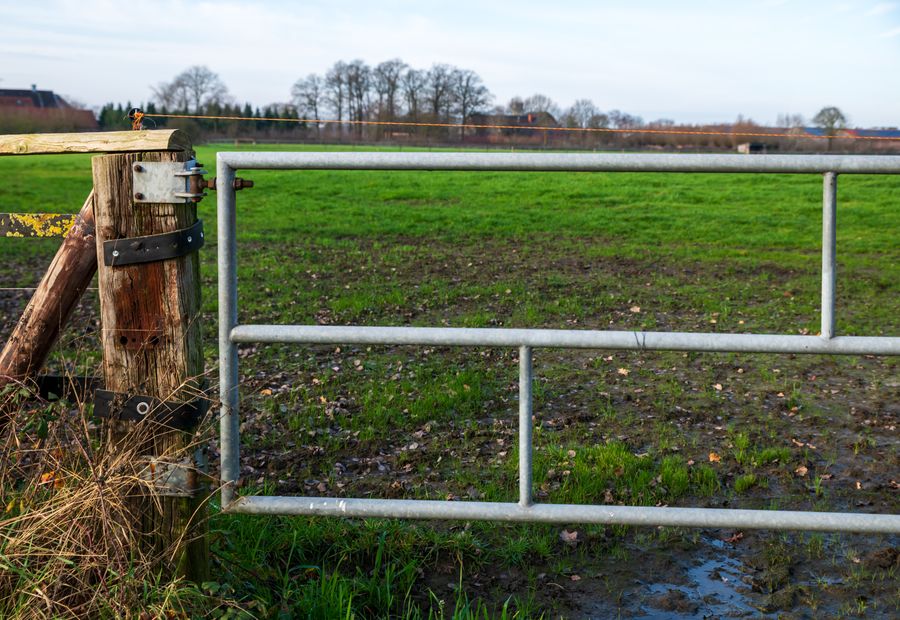
Columbia Farm Fence hangs farm gates, walk gates, double gates, ranch entrances, and cattle guards for pastures, drives, and working pens across Columbia, Ashland, Centralia, Hallsville, Fulton, New Franklin, and the farms of Boone, Callaway, Audrain, Howard, and Cooper counties, Missouri. We hang new gates on new fence and reset gates whose posts have walked out of plumb.
Gates are where a fence fails first, so the hardware and the post both get specified. We hang Tarter tube gates in the common widths and Priefert gates where a customer wants the heavier frame, on hinge posts that are larger and deeper than any line post on the place. A hinge post goes four feet down at least, gets braced back into the fence line with a horizontal rail and a twisted brace wire, and on a wide or heavily used opening it becomes a steel pipe post set on a concrete footing instead of wood. Hinges get set with the top pin down and the bottom pin up so the gate cannot be lifted off, and the gate hangs with a little rise toward the latch so it swings shut rather than open. A tube gate hung on an unbraced line post is the gate you are dragging by next spring.
Entrance Ground in Boone County
An entrance takes traffic, and traffic is what the two local soils handle differently. A drive off a bottom road near Rocheport or McBaine sits on deep alluvium that pumps and ruts when it is wet, so gate posts and cattle guard footings go deeper and wider there. Upland claypan carries a footing well but perches water right under the topsoil, so the approach needs to shed water away from the opening or the gate swings through a wallow every spring. We set the pad before we set the gate.
Ranch Entrances and Headers
An entrance header is a pair of posts and a beam over the drive, in pipe or in timber, usually carrying a name or a brand. It has to clear a loaded hay truck, and the two legs carry a real wind load, so both go on footings sized for it rather than on gate posts.
Get It Hung Right
New gate, new opening, or a gate that has quit closing. Call (573) 555-0157.
Why does my gate drag on the ground?
The hinge post moved. A gate hangs off one post and levers against it every time it swings, and that lever works the post toward the opening a little at a time. A post that leans even slightly drops the latch end an inch or more. Rehanging the gate on the same loose post buys a few months. The fix is to reset the hinge post deeper, brace it back into the fence line, and then rehang.
What gate width should I order?
Twelve feet handles a truck, a trailer hitch turn, and cattle moving through. Sixteen feet is the standard for field entrances where a tractor with an implement comes through, and it is what most people wish they had ordered. Four foot walk gates go beside a main gate so nobody swings the big one to check water. Wider than sixteen and a single leaf starts to sag under its own weight, so we hang a double.
Do I need a cattle guard, and what does it sit on?
A cattle guard makes sense on a drive you use every day where stopping to open a gate gets old. It needs a footing on both sides that carries whatever crosses it, set below the frost line, and a cleaned out pit under it so debris does not fill the void and give cattle a floor to walk on. Wing fences on both sides steer the stock away from the edges. A guard laid on dirt with no footing settles and cracks.
Which latch actually holds?
The one your cattle cannot work. A chain and hook is fine on an interior gate that people use. Boundary and road gates want a positive latch that self catches when the gate swings shut, plus a way to lock it. Horses learn a lever latch fast, so horse gates get a latch with a second motion in it. We hang the latch post plumb, because most latch failures are a post out of line rather than the hardware.