Farm Fence Installation in Columbia, MO
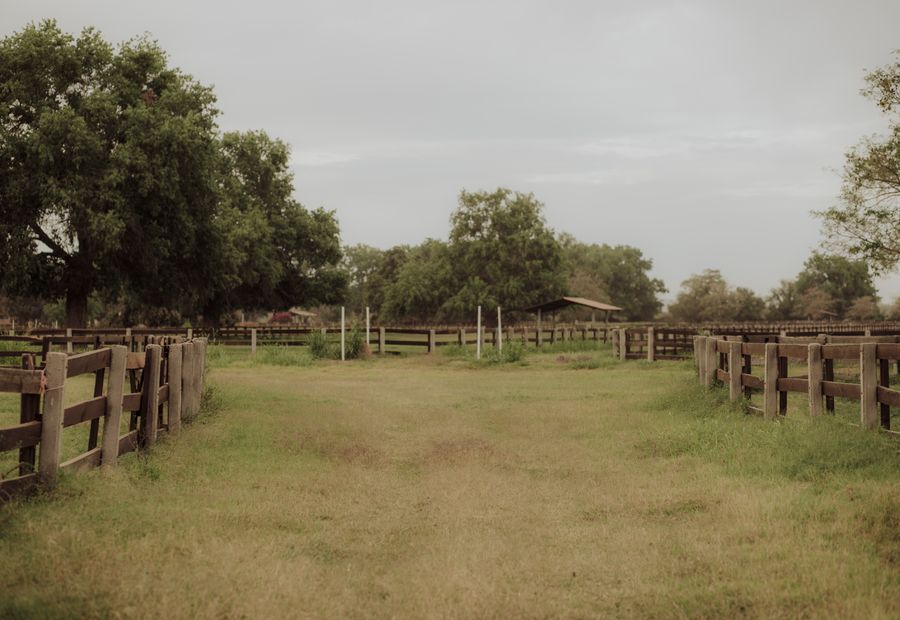
Columbia Farm Fence is a farm fence contractor building woven field fence, high tensile and electric fence, barbed wire, board and rail fence, pipe corrals, fence line clearing, and farm gates for cow-calf pasture, horse places, and crop ground across Columbia, Ashland, Hallsville, Centralia, Harrisburg, Sturgeon, Rocheport, Fulton, and New Franklin. We serve Boone, Callaway, Audrain, Howard, Cooper, and Moniteau counties, Missouri.
Every strand in a fence pulls toward the end of its run, and the end assembly takes that whole load. So we build an H-brace at each corner, end, and gate opening: two posts, a horizontal rail near the top, and a brace wire wrapped twice on the diagonal and twisted until it rings. Brace posts measure six to eight inches across and go three and a half to four feet down. We backfill in lifts and tamp each lift, because packed soil grips the full column of the post and lets the post be reset years later. Concrete poured around a treated post does the opposite and holds water at the collar until the wood rots there. Posts are CCA ground contact treated pine. Woven wire goes up in Stay-Tuff fixed knot or Red Brand, always with Class 3 galvanized coating, which carries roughly three times the zinc of Class 1. Loose wire strung on driven T-posts with nothing braced at the corner is the fence that sags by the second summer.
Two Kinds of Ground in Boone County
The Missouri River makes the south edge of this county, and the bottom ground along it is deep alluvium. An auger drops through it fast. That same easy digging is why a post there needs extra depth, and why we set floodgates and tie-downs where a line crosses a draw that carries water. Upland Boone County is the opposite problem. Claypan sits under a foot of silt loam, and the clay stops water at that break. A hole slicks over in wet weather, the auger loads up, and a post backfilled into that slick sleeve never grips. We wait out the wet on upland and scarify the hole wall before backfill.
Cattle Ground and Horse Ground
Mid-Missouri runs cow-calf pasture next to small horse places, and the two want different fences. Cattle lean on a fence, so they get woven wire or barbed wire with tight bottom spacing and heavy corners. Horses run into a fence they cannot see, so they get board, rail, or a visible top line. We spec the fence to the stock, not the catalog.
Season and Booking
Builds run spring through fall. Quotes run all year. Frozen or saturated ground is a real reason a job waits, and we would rather say so than set a post in mud you will pay for twice. Call (573) 555-0157 and we will walk the line with you.
What is the fence law in Missouri?
Under the general fence law, which covers most of the state, the person who owns the livestock is the person responsible for fencing them in. Where both neighbors keep stock against the same division fence, each one keeps up his own half. A lawful fence is at least four feet tall, built of wire or boards on posts set firmly and no more than twelve feet apart. A short list of Missouri counties has voted itself onto the local option law instead, and there both owners share the cost whether or not either runs stock. Boone County is not one of them, but the answer can change one county line over, so ask your county before you split a bill.
What is the recommended distance between posts for a farm fence?
It depends on what the fence is made of. Woven field fence and barbed wire hold their line on wood posts set twelve to sixteen feet apart. Driven steel T-posts go closer, eight to twelve feet. Board fence follows the lumber, so posts land eight feet on center. We pull the spacing in on rolling upland and anywhere cattle bunch at a gate or a water tank. Missouri's lawful fence rule caps the gap at twelve feet, which is a legal floor and not a design.
What is the minimum depth of a fence post in Missouri?
Missouri does not set one. The statute says posts must stand firmly and leaves the depth to you. Our working rule puts line posts two and a half to three feet down and corner, end, and gate posts three and a half to four feet. Every one of them sits below the frost line, which runs two to three feet through mid-Missouri. The simplest check is to match the post to the wire: bury as much post as the top wire stands above the ground.
What drives the price per foot on a farm fence?
Fence type sets the range first. Barbed wire is the cheapest foot to build, woven field fence sits above it, and board and pipe run highest. After that, three things move a quote more than anything else. How much brush and tree line has to come off before a post goes in. How rough and how wet the ground is. And how many corners, ends, and gate openings the layout calls for, because each one is a full brace assembly rather than a post. We walk the line, count the assemblies, and price the real job.